On this page
Short answer
An AI model helped researchers read 1,009 pages of notebooks left by Kurt Gödel, one of the most important logicians of the 20th century. In a couple of days, Claude produced a 650-page digest of the material and listed 663 theorems, proof sketches and proof ideas. Most of them have since passed a computer proof checker: Gödel had proved far more than anyone knew.
What happened
Since 2017, the Finnish logician Jan von Plato has led a University of Helsinki project to understand 16 notebooks that Gödel wrote in the early 1940s, after he settled in Princeton. Much of the text is written in Gabelsberger, a German shorthand that was already obsolete when Gödel used it. Von Plato says he is "one of only six people who can read it in the world," and progress was about a page a week, The Guardian reports.
In August, at a conference in France on AI and theorem proving, computer scientists suggested he try Anthropic's Claude. Back in Helsinki, he gave the model his transcriptions of the notebooks, six books he had written on Gödel and other scholarly literature.
"In a couple of days, I got to see a 650-page explanation of the workbooks," von Plato told The Guardian. "It had to be controlled page for page, but it's basically a work that is impossible to do for human beings."
The results so far
- 663 theorems and proof ideas. According to von Plato, about 400 were verified exactly as stated in Coq, a program that checks proofs step by step. About 200 were repaired, for example by making a statement more precise, and about 50 turned out to be false, which he calls "no wonder" for working notes.
- A famous claim, almost confirmed. Gödel once said he had proved the independence of the axiom of choice in the 1940s, decades before Paul Cohen won the 1966 Fields Medal for the result. Claude found that the notebooks contain the proof "almost": Gödel was "just one step away," with one definition he had written correctly two years earlier.
- New directions. Von Plato says the notebooks contain "dozens of anticipations of results not known until the 70s and 80s" and 14 themes in logic nobody has pursued yet. "Gödel was far ahead of his time," he said.
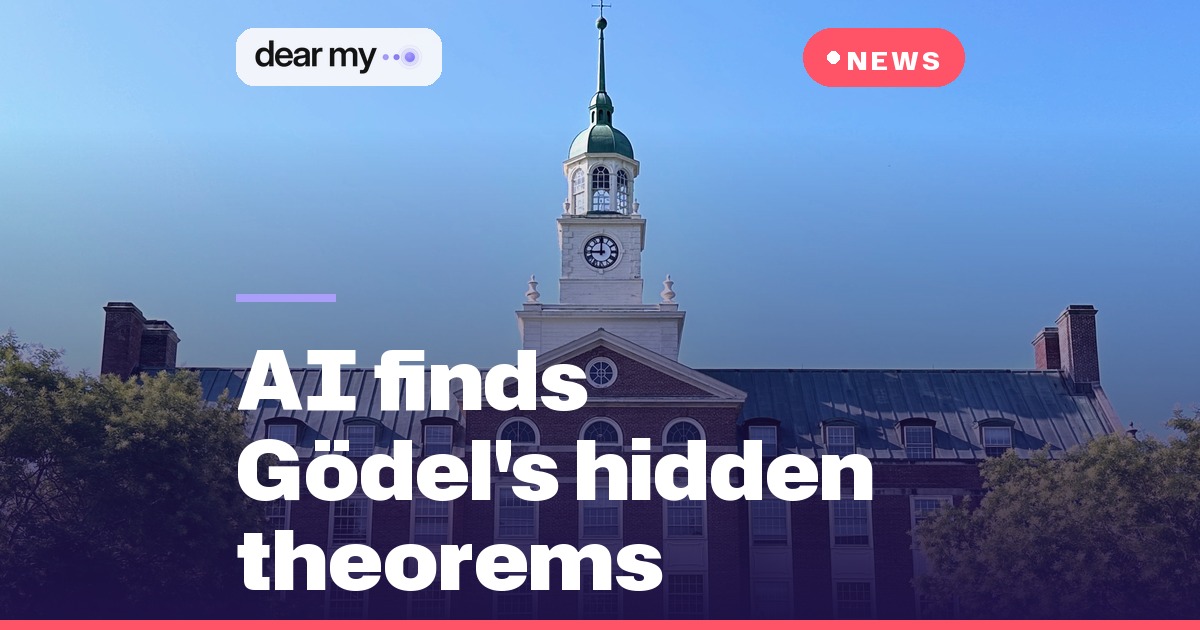
The Institute for Advanced Study in Princeton, where Gödel worked from 1933 until his death, highlighted the story and notes that the team now plans to explore his physics and cosmology notebooks. As MACCUS points out, no paper or proof files have been published yet, so the full details are still to come.
Why people are talking about it
The story reached the front page of Hacker News with almost 400 points, and was covered by outlets from MACCUS to Spain's La Razón. It shows AI helping an expert see a thousand pages "as one piece," not replacing him.
What it means if you use AI
- Long documents are a real strength. Feeding an AI your own notes, books and transcripts and asking it to connect the dots is exactly what worked here.
- Checking still matters. The digest was verified page by page, and the theorems were run through a proof checker. That is a good habit for any important AI summary.
Quick FAQ
Did the AI read Gödel's shorthand directly? According to The Guardian, it worked from von Plato's transcriptions, plus his books and other literature.
Is the research published? Not yet. The findings so far come from von Plato's interview with The Guardian on November 13, 2026.
Sources
- The Guardian (Nov 13, 2026): 'Ahead of his time': AI helps unlock discoveries hidden in notebooks of man who transformed maths
- Institute for Advanced Study (Nov 13, 2026): AI Helps Unlock Discoveries Hidden in Notebooks of Man Who Transformed Maths
- MACCUS (Nov 14, 2026): Claude found 663 theorems in Gödel's notebooks. About 400 passed a proof checker as stated
- La Razón (Nov 14, 2026): La inteligencia artificial descubre cientos de teoremas ocultos en los cuadernos de un genio de las matemáticas
- Cover image: Fuld Hall, Institute for Advanced Study, Princeton, NJ, by Zeete, Wikimedia Commons, CC BY-SA 4.0
Written by our editorial team with the help of AI tools. Spotted a mistake? Tell us in the discussion.