On this page
Short answer
On November 20, 2026, Anthropic mathematician Levent Alpöge announced that, working with Claude, he believes he has found a proof of the Riemann hypothesis, the famous 1859 problem about how prime numbers are spread out. The proof comes as computer-checkable Lean code, and independent mathematicians say it has passed the first major checks. The final checks and a readable write-up are still to come.
What happened
Alpöge posted a short note on his website: "I believe I have, working with Claude, discovered a proof of the Riemann Hypothesis." He says the method extends to the so-called Generalized Riemann Hypothesis, and that he and Claude "have also formalized the arguments without assumptions."
Instead of a huge paper, he released the proof in Lean, a programming language in which every step of a proof is checked by a computer. It is about 17 million lines of Lean code, AP reports. According to Alpöge's timeline, the work began on October 6, and he describes Claude as the partner that "far outpaced me near the finish line" while he guided the overall approach.
Within hours, MIT mathematician Andrew Sutherland independently compiled all 175,187 modules without errors. On his public verification page, he reports that the main theorem uses Mathlib's own definition of the Riemann hypothesis, depends only on Lean's three standard axioms, and is accepted by two independently written proof checkers. "Honestly the chance that anything is fishy here is approximately zero," he told Scientific American. One more step, a full "comparator run" confirming that the code proves exactly the intended statement, was still running at the time of his last update (November 20, 23:05 CET).
Why it matters
The Riemann hypothesis is often called the most important open problem in mathematics. It predicts that the "zeros" of the Riemann zeta function all lie on one line, which would mean prime numbers are spread out about as evenly and randomly as possible. Many published results already assume it is true.
"If this fully checks out, it is clearly a historic milestone in mathematics," Fields Medal winner James Maynard told Nature.
It also builds on earlier progress. In August, Anthropic reported that a research version of Claude raised a long-standing bound on how many zeta zeros are proven to lie on that line, from 41.6% to 67.2%.
What it means if you use AI
- AI can be a real research partner. This was a mathematician and an AI working together over weeks, not a single prompt.
- Checking is what builds trust. The result is being taken seriously because a computer can verify every step, and outside experts can rerun the checks themselves.
- Good habit for everyday use: for anything important, ask your AI to show its steps and verify the key facts with a source.
Quick FAQ
Is the Riemann hypothesis officially solved? Not yet. The Lean checks look very strong, but the final comparator run, a human-readable paper and review by the wider math community are still ahead.
Did Claude do it alone? No. Alpöge led the work with Claude, and he plans to write the argument up properly and expects it to be simplified.
What is Lean? A proof language and checker. If a Lean proof compiles, the computer has checked every step from the stated definitions.
Related reading
Sources
- Levent Alpöge, announcement note (Nov 20, 2026): I believe I have, working with Claude, discovered a proof of the Riemann Hypothesis
- Andrew Sutherland, MIT (Nov 20, 2026): Verification files for the Lean proof of the Riemann Hypothesis
- Scientific American (Nov 20, 2026): The AI Riemann hypothesis proof is almost certainly true, independent mathematicians attest
- Nature (Nov 20, 2026): Mathematician says he and AI solved Riemann hypothesis
- AP (Nov 20, 2026): Anthropic worker claims to have solved a Holy Grail of math problems with the help of AI
- Anthropic (Aug 10, 2026): Learning more about Claude's mathematical capabilities
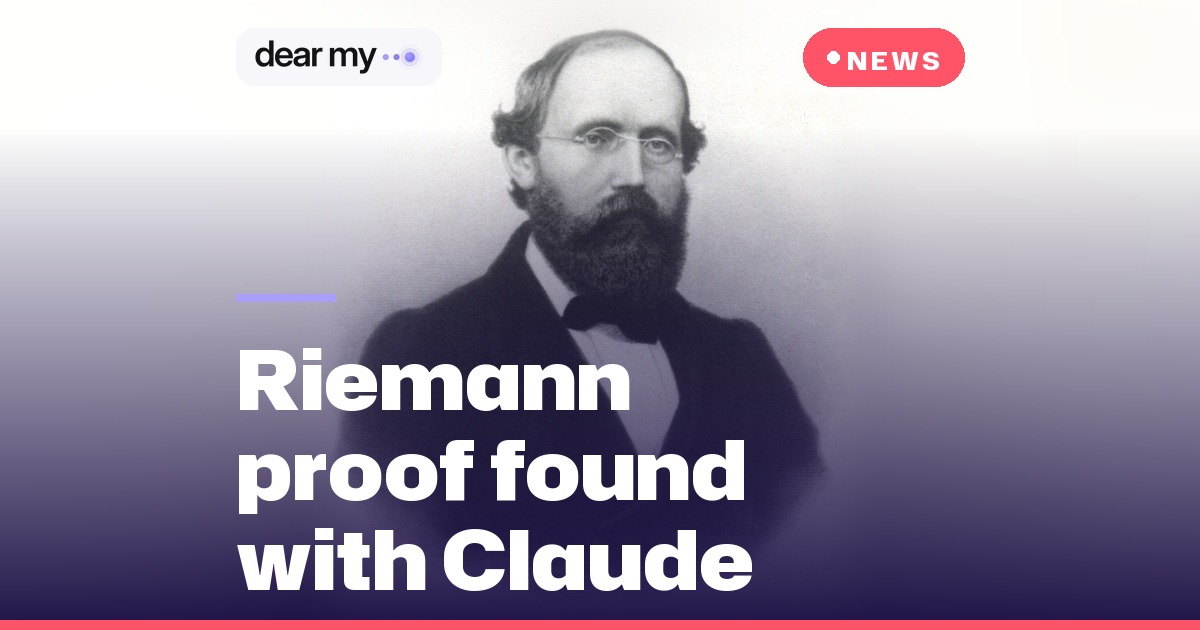
- Cover image: Portrait of Bernhard Riemann (1826-1866), Mathematician, 1863, Smithsonian Institution Libraries, via Wikimedia Commons, no known copyright restrictions
Written by our editorial team with the help of AI tools. Spotted a mistake? Tell us in the discussion.