On this page
Short answer: Google says its Project Suncatcher prototype satellite has sent back its first AI answer from space: a haiku written by Gemma 4, Google's open model, running on a data center class TPU chip in orbit. It is a small "Hello World" test, not a working space data center, but it shows that today's AI chips and models can run in orbit. Google plans to launch 2 linked satellites in 2027.
What happened
Google launched the Suncatcher prototype on October 1, 2026, on SpaceX's Transporter-18 rideshare mission. The satellite was built with Planet. After a few weeks of commissioning, including powering up the TPU trays and running early machine learning tests, Google reached what it calls its "Hello World" milestone this week, writes Travis Beals, Senior Director, Paradigms of Intelligence, in a Google blog post dated October 30.
During a ground-station pass, the team sent a prompt to Gemma 4 on board, asking for a haiku about being in space. The answer came down as the satellite passed over Svalbard, Norway:
Google says it then tried space-themed limericks and prompts that reported the technical status of the payload. According to TechCrunch, the satellite carries 4 TPUs and generates up to 1 kW of power, but it can run only one TPU at a time, for about 20 minutes. A Google spokesperson told TechCrunch the satellite is operating nominally.
Why people are talking about it
It is a very shareable first: an AI model writing poetry about Earth from orbit. The story was covered by The Verge and TechCrunch on the same day, and threads about it appeared on r/technology, r/space and r/Futurology.
What it means if you use AI
- The same kind of model you can use. Gemma 4 is an open model that developers can download and build into their own apps, so the AI in orbit is a publicly available model, not a secret system.
- A long-term bet on energy. Suncatcher is a research moonshot exploring whether AI computing could one day be powered by sunlight in space. Google describes it as a long road.
- Nothing changes for your chats yet. Your chatbot or AI companion still runs on Earth. Google's next steps are tests of heat and radiation, and the twin satellites in 2027.
- Reliability is the real question. TechCrunch notes that radiation can flip bits in memory. Google's ground tests suggested this matters less for answering prompts than for training models; orbit will show if that holds.
Quick checklist
- Read Google's own post for the exact claims, not just the headline.
- Remember this is a demo: one prompt, one chip, short sessions.
- Curious about Gemma? Look for it in apps or tools that offer open models.
- Watch for Google's results on heat and radiation, the next milestone.
FAQ
Is Google running ChatGPT-style services from space now? No. It is one prototype satellite running tests.
Who wrote the haiku? Gemma 4, prompted by Google's team on the ground.
Facts come from Google's blog posts of October 1 and October 30, 2026, with reporting from TechCrunch and The Verge (October 30, 2026), read on October 31, 2026.
Related reading:
- Gemini 4 Carbon: Google's new #1 AI model, coming soon
- Mistral Large 4 is now open: what it means for AI users
- How much water does one AI prompt really use?
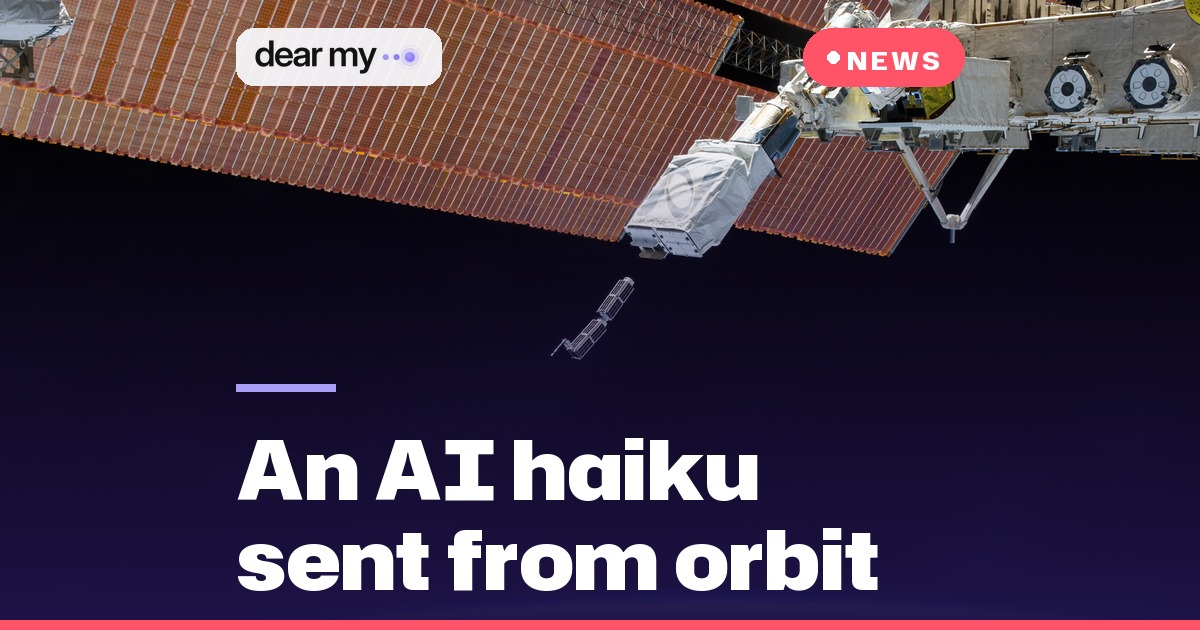
Cover image: Planet Labs "Dove" satellites leaving the International Space Station in February 2014, photographed by an Expedition 38 crew member. It shows earlier Planet satellites, not the Suncatcher prototype. Photo: NASA, via Wikimedia Commons, public domain.
Sources
- Google blog (Oct 30, 2026): We've received our first response from the Project Suncatcher prototype satellite
- Google blog (Oct 1, 2026): Our Project Suncatcher prototype satellite is in orbit
- TechCrunch (Oct 30, 2026): Google's first data center satellite is online and writing poetry
- The Verge (Oct 30, 2026): Google's satellite AI server transmits its first response to Earth
- Cover image: Planet Labs satellite launch from ISS, NASA (Expedition 38), Wikimedia Commons, public domain
Written by our editorial team with the help of AI tools. Spotted a mistake? Tell us in the discussion.